

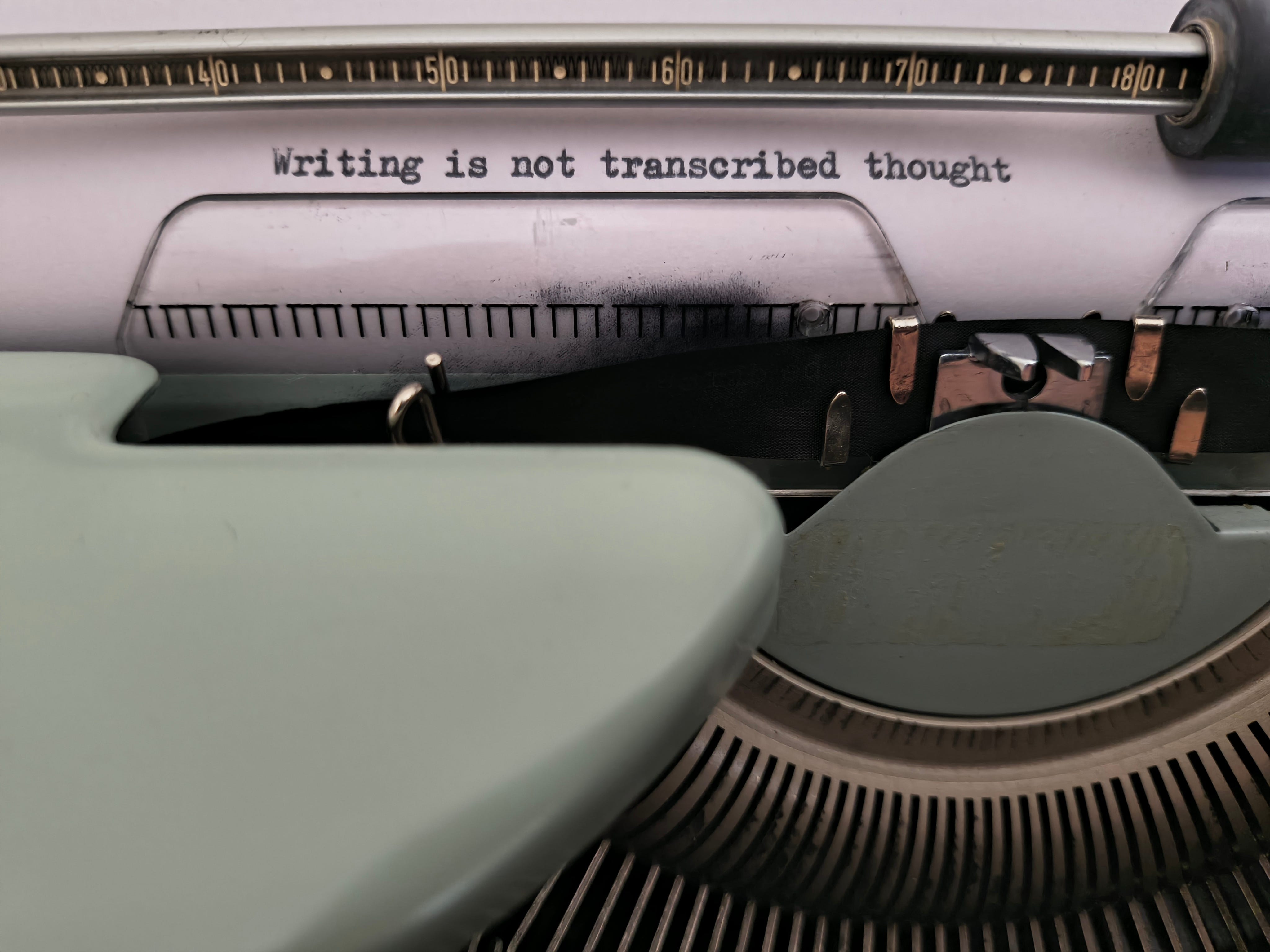
When the writing is going well at the typewriter, words splat one after another on the page, and each one looks back at me with a memory, a felt sense, or a thread asking to be followed. Where I’m positioned in relation to all of it lights up where the writing could go next.
If I’m mid-sentence describing morning light, the act might surface the yet-unwritten possibility of a kitchen I haven’t thought about in years, and, in the same instant, suggest three possible ways of continuing the phrase, each of which would follow a different rhythm and take a different path through the piece. These in-process impressions are vivid but they’re peripheral. You can only write one word at a time, and move in one direction at a time.
So you choose a handle to the next experience and follow it. The choosing isn’t a loss. Any move with life in it stays available. When you're settled into the forward flow, the paths you didn't take remain as seeds, or else they feed into the next line on their own. Sometimes you can choose one broad enough to carry several at once.
The common assumption, even among people who would say otherwise, is that you think something, then you write it down. That’s not my experience.
The words arrive and the thought forms as they land on the page. You didn’t know what you were going to say until it’s being said. That doesn’t mean attention is coming after the fact, like writing is stumbling in the dark. It puts attention right where words arrive.
Eugene Gendlin, the philosopher and psychologist, spent decades studying the border between what the body knows and what language can carry, and his insight was that before any articulate thought, there’s a felt sense — a bodily, pre-conceptual knowing that is richer than whatever words eventually meet it. Language doesn’t translate the felt sense. It crosses with it. The two interact and something new forms at the intersection.
That’s another way of explaining what I experience at the typewriter. The felt sense is there in the form of those handles to potential experience, the language is arriving through the keys, and the two are meeting in my view as words land on the page. The page is where the crossing happens.
Gendlin’s other insight is that the felt sense is precise, even if it’s not verbally precise. You can feel the difference between what you think you’re feeling and what you’re actually feeling. Likewise, you can sense when the words you’ve written are close to something, versus when they’ve been pulled off course by the inner critic, by a learned register, or by emotions flooding faster than the writing can track. The sensing is what matters. It rests prior to the felt sense, and the writing practice trains it.
For me, the easiest way to understand writing’s relationship with thinking is through experiencing thought as a rhythmic experience. There are different rhythms to different kinds of thinking. When you’re sitting quietly, turning something over in your mind, there’s a rhythm to that — circular, recursive, maybe the same few thoughtforms iterating. When you’re talking with someone, there’s a different rhythm that’s responsive, social, and juiced by the other person’s presence, spurred by the desire to be understood. These are not the rhythm of writing.
Writing is faster and more tactile than sitting and thinking, because the body is moving to make marks. It’s slower than talking, because the mechanical act takes time. And it’s private in a way that conversation never is, even conversation with yourself.
When you write with a tool that externalizes the act, you can see the phrases as they’re formed, and part of your attention is occupied with the instrument. You’re aware that you’re using a thing. It’s like learning to ride a horse or drive a car. The part of your mind that would otherwise be standing guard over what you’re about to say, monitoring it for correctness, shaping it into something presentable, is busy with the machine.
So then it becomes possible to widen your perception outside the ordinary channels that tend to shape everything into familiar registers. Those channels are still there, but the tactile engagement opens a wider field around them. And in that wider field, new experiences have room. The wider field isn't something the typewriter creates. There's a part of you that was already there, watching, registering, independent from what arrives. The instrument occupies what was drowning it out, and the rest opens.
The forward momentum of the writing and the physical engagement creates a kind of safe outer container that affirms you’re making something. Your hands are busy, the sound is steady, and inside that container, a reflective inner space opens. The inner and the outer hold each other. That’s also where the crossing happens.
Part of what makes writing a safe space for inner exploration is that what’s on the page is workable. When a sentence arrives and it surprises you, the writing is physical and external, so you can respond to it. You can direct it somewhere else, amend it, or follow it further. The page holds it all for you while you decide what to do next.
And there’s something playful about the confrontation of seeing your own words on the page. Seeing something uncertain that you made is different from having an uncertain thought. The page gives it enough reality to take hold inside, to strengthen or clarify something that was only a wisp before the keys struck. And because you made it, you get to decide whether to keep going in that direction.
If you slow the process down, you’ll notice there are a few things running at once: what you presume you’re feeling, what you’re actually experiencing, what you’re thinking about what you’re feeling, and what you’re writing. The writing might be ahead of the thinking, or the thinking might be narrating a familiar story about the feeling while the writing undermines it.
That’s why the most troubling blocks that come up here aren’t the caricature of writer’s block, the blank page and the blinking cursor. Actually, they’re the habitual patterns you’ve learned to shape language so it arrives safely or correctly or as the version that sounds like important writing. A good writing practice gives you a space where you can feel the moment where the habitual phrase arrives and sense what it replaced without having to force anything.
Psychologist Russell Hurlburt’s decades of research on inner experience found that many people don’t think in words at all. Some think in images, some in what he calls “unsymbolized thinking,” a clear knowing with no verbal or visual medium. The narrating mind is a learned overlay on something that was already there.
A writing practice lets you drop beneath the mental overlay so the felt, somatic, and associative layers can participate in what arrives on the page.
Too often, people frame a writing practice as self-expression. It’s helpful to find your voice, speak your truth, and let it out. That’s fine as far as it goes, but it doesn’t go far enough. What a sustained practice can do, over time, is equip you to articulate what’s genuinely yours, and this isn’t limited to your feelings. It’s also about tapping into the field of perception available to you.
Getting in touch with that involves deconstructive work: noticing the habitual patterns, staying with what’s uncomfortable; and constructive work: building the capacity to write from the felt register, to sustain the practice long enough that the inner and outer spaces learn to hold each other.
If you want to feel what I’m describing, here’s one way in. Write for five minutes using only one-syllable words. When the timer stops, sit with what you wrote. Notice where the language came from. Notice what it felt like in the body to write under that constraint. If you’re holding yourself to any sort of expected forward speed, it’ll be disjointed:
I walk and sit and to see he she and me we in sky in car sit cup mug chair she and me we out sun cloud walk by man wine dog cloth stand ask how much pay bill give tip get up we hold hands he says she look point look there bird song flit
After that bit, write for awhile with no constraint, starting from wherever the first piece left you. See how the experience changes when the language is less constructed and can simply arrive. Where you were less aware of choosing and more aware of receiving?
The contrast between the two can make the layers tangible. You can feel where you’re writing from, and that felt awareness is what a good practice is about.
If you want to explore this more, try the free five-day practice via email and let me know what you think.
I love considering the somatic connection to writing and inner exploration. Thanks so much for sharing.