

What if the greatest act of creative sovereignty is choosing the tools that work for you, rather than the ones you’re told are the best?
I’ve spent years switching between supposedly obsolete tools—typewriters, writing by hand, old film cameras, actual pottery wheels—and supposedly optimized ones like, well, AI. You’ve probably been trained to believe that newer tools are better tools, and that resisting them makes you a Luddite or a hipster. But some tools were already as good as they ever needed to be.
Abandoning the old tools might mean boosting your efficiency but it also means that you lose the virtue that can only come through hard work, and before long you don’t even notice it’s gone. The CEOs and techbros that want you optimized don’t care whether the old way worked for you. They need you to believe it didn’t.
Weird typing
Years ago I abandoned QWERTY to learn Colemak, an alternative keyboard layout that rearranges keys to reduce finger travel and keep the most common letters on the home row, and it allowed me to type with roughly 38 percent less finger movement. Hot damn. It took a couple of weeks, cold turkey, to make the switch, and after that, I moved into a more frictionless way of typing on a keyboard. I could just sort of think my words right onto the screen.
After all, QWERTY is sort of arbitrary. One coincidence about the layout that is not a coincidence: you can type the word TYPEWRITER using only the top row. Apparently this was so that salesmen could show off the machines without the key arms jamming.
Funnily enough, I spent the last couple of weeks un-learning Colemak and re-learning QWERTY, because I just suddenly got stoked about using old manual typewriters again.
Typewriters were the optimization back in the day. At the time, they were a new technology. Lots of grumpy writers railed against them. Some less grumpy writers found novel ways of using them.
Using a typewriter 50 years ago wasn’t a very interesting or revolutionary thing to do. But there is something fascinating about taking a piece of equipment (or a practice) and bringing into the context of the here-and-now.
Life keeps bringing me reminders how practices and tools just absolutely cannot be made obsolete. It would be a huge mistake to believe that anything actually becomes obsolete, partly because such a notion pretends that there is some grand vision behind technological innovation. There is no such unified grand vision. It’s just ideas with funding and businesses competing and marketing campaigns. Things improve and new products get released, but that doesn’t mean much. If anything, we are shrinking ourselves in an attempt to live within our devices.
A typewriter, as a writing tool, is by no means superior to handwriting. That’s just not the way to look at things. Typewriters offer a uniquely valuable way of engaging with the writing process, particularly for people who are fed by the tactile edges of experience. They bring about a certain cadence to writing. They have a strong rhythmic element. They make noise, and this has the effect of creating its own kind of ambient environment, which can be hugely generative. They’re perfectly suited for freewriting, because there are no interruptions, and because going back and editing your text would be so counter to the strong forward momentum they induce.
What are we but sheep, I say, if we simply get coaxed along by the new optimized whatnot. But let us not become contrarian hipsters who define ourselves by being backward and obnoxious. I say we use what works for us, dammit. And it is not a good thing when forces (usually corporate) want to remove those options.
It’s not good that cursive is no longer taught in schools. Not good that AI is writing for people to such an extent that they no longer value their own voice or the beauty of slogging through the creative process.
I always like what Paul Thomas Anderson said about film versus digital. Digital allows you to do things cheaper and faster, but digital is “like watching the best TV screen in the world as opposed to watching 24 frames flicker through light, which is a hypnotic and wonderful experience.”
Digital looks different, and the disappearance of chemical photography means that cinematographers no longer have the same concerns about lighting for film. It’s automagically taken care of by the new device. There are elaborate post-production tools that do what used to happen in-camera. When the old-timers had to put a ton of will into cultivating the skill of ensuring the lighting was just right, the art gods rewarded these greybeards in exchange for their dedication. So yeah, we can get the result, but what about the unseen beauty of the absolute warfare of the creative process?
Each technology is its own attainment. Some are their own pinnacle. They need scale no greater heights.
And of course it’s not a realization that need only come in hindsight. Study the design assertions of old typewriters and you can also see the same human arrogance that must have been there in equal measure to what blowhard techbros and douche CEOs are going on about today, many of the machines with their branding as “the ultimate writing machine.”
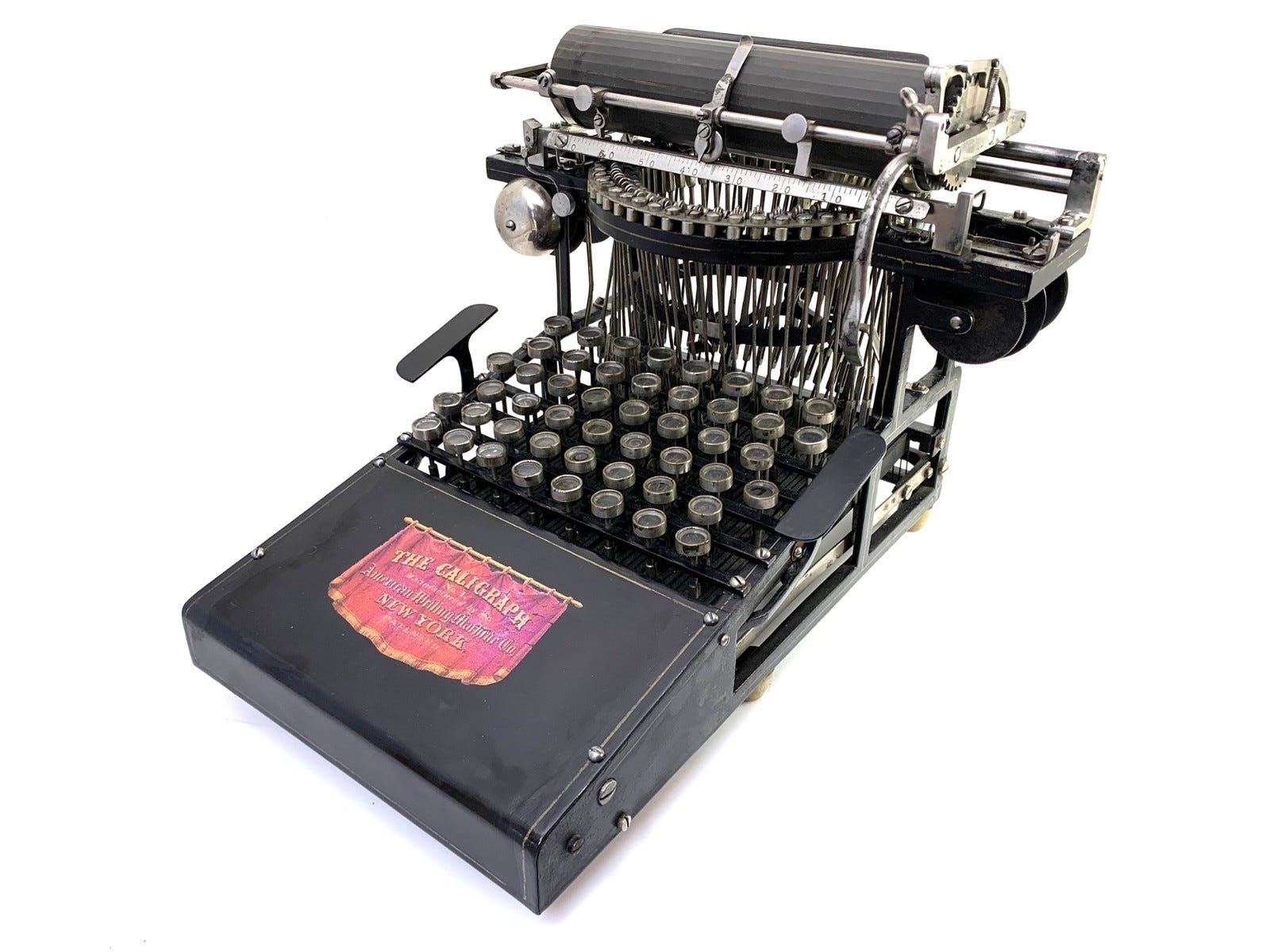
Far more excellent than a printing press, sir, you can fit it in the back of your car. Can’t do that with your printing press, can you, little bro?
I have always loved typewriters but had long abandoned them for more obvious choices, like typing on a goddamn computer. It may seem strange that I’m so cautionary about being excited about new tech. I guess the AI debate has made it all very real.
AI is great at weird challenges, like generating multiple iterations of a thing, or being able to take tons of unstructured input and produce some sort of highlights and organization. It can be useful at going from rough idea to producing a competent draft. And it’s “getting better,” which is strange because the consensus seems to be that it’s going to take away all of our jobs someday. So, for those who like what they do, what is actually better about that?
I use AI a lot these days, which has the effect of making me less stoked about the rise of AI than what my science fiction self might want to idealize as being possible. I fiddle with it a lot, and I’m unconvinced that human collaboration wouldn’t be better in many cases. It’s a symptom of our increasing isolation that we think of it as a creative companion. It can be a hell of a handy tool, far better than Googling used to accomplish. But no, AI should be regarded as a cost-cutting measure rather than a cutting-edge device.
AI is great at output. But output matters less than process.
I’m pro-creativity, pro-authentic voice. This all comes through practice, by stripping away layers, through discipline and commitment to the creative process.
In the spirit of celebrating the obsolete, there’s a concept from ancient Greek philosophy worth returning to here: virtue as something cultivated. We become what we repeatedly do, the way in which we do it. Ethos anthropos daimon—character is fate. Who we become isn't handed to us but built through the grain of daily action. We become what we repeatedly do, and the way in which we do it.
We live and we die, but the actions we take part in have effects that go on and on, most of them we’re completely unaware of. We are not products, despite how our actions are monetized and tracked and manipulated.
There is a radical act of self-sufficiency in choosing creative sovereignty, in choosing tools and practices that serve the process more than the outcome.
All of this may sound abstract—virtue, process, creative sovereignty—until you see what it looks like when these things are treated as disposable. Case in point: what's happening right now in Hollywood.
Why the Netflix deal is bad for Hollywood, and actually everyone
In early December, Netflix announced it would acquire Warner Bros, and Paramount countered with a hostile bid. It's still playing out, but no matter what happens, it’s going to suck.
The Netflix deal will be the final piece in the puzzle of the tech industry’s takeover of Hollywood. Hollywood is far from an enlightened organism, but it’s far better for it to be sovereign and to have movie theaters than for tech to consolidate everything and treat it as mere content. That puts us closer to a future in which AI replaces everything it can.
In April, Netflix’s co-CEO called movie theaters “an outdated concept.” He said he wasn’t bothered by the disappearance of so many cinemas because they can watch at home. That’s his enlightened dream. It’s shit.
Do it all
So what do you do?
I’m starting the new year with a couple of typewriters loaded with paper and ready to use on a side table in my office. A page half-finished, always there. I can add a sentence whenever I want—no booting up, no risk of losing power. Just the machine and whatever I’m willing to put down.
I kept journals for years but fell out of the habit as a disciplined thing. I want that back. Writing from observation in the spirit of Thoreau, Chekhov—just writing things down, trusting what you see is enough. Naming what’s in front of you and what’s happening.
This kind of writing is closer to what a musician does with scales. It’s like doing drills, except the cool thing about writing is that you get to keep what you put down and you get to keep the effect of the practice.
This kind of work brings presence down into the marrow of the thing, into the fundamentals. Nothing’s optimized.
That’s the bet. Character is fate. Who you become is built through daily action and sometimes that means choosing the slower thing, the thing that asks more of you.
Each technology carries its own mode of attention and its own relationship to time and craft. Some things—handwriting, film, typewriters, movie theaters—are their own pinnacles. They’re good just as they are, more or less, as part of a living tradition. They need scale no greater heights.
The Understory
For this week’s understory, I’m sharing one of those poetic images I managed to grab from the ether and slap down, stroke by hammering stroke, onto the printed page, using an Olivetti Lettera 22.
Feel free to share a piece of your own. A quote, a short draft, an excerpt, anything you’ve written recently that is still a work in progress with some life in it. Just post it below as a comment (click Reply or whatever it says and just paste it in).
to be a bird capable of flying overseas

wings and the rushing flows of a madness that must feel soft,
weightless sluices, moments of all-spanning quiet,

of loft, vacancy, and neighboring currents that rush to equalize all underneath
I took my wife’s typewriter to Bremerton to get serviced recently, which, incredibly enough has TWO typewriter stores. The guy who founded the store I went to is a legend in the typewriter world (https://www.nytimes.com/interactive/2025/11/20/us/typewriter-repair-seattle-bremerton.html) and I saw an opportunity to chat him up on all things typewriter so I seized it. I observed that he probably had machines from the 1950s in there. He said he had one from the 1890s! It’s amazing to have a machine from that era still perfectly operational where if you buy a new MacBook Pro today, it will without question be useless within 20 years. And that’s probably a high estimate.
Love this Stephen. The other night I was tossing and turning, resisting the ridiculous pressure from ev-eree-one to use AI (constantly, first, exclusively?!)so thanks for this.