

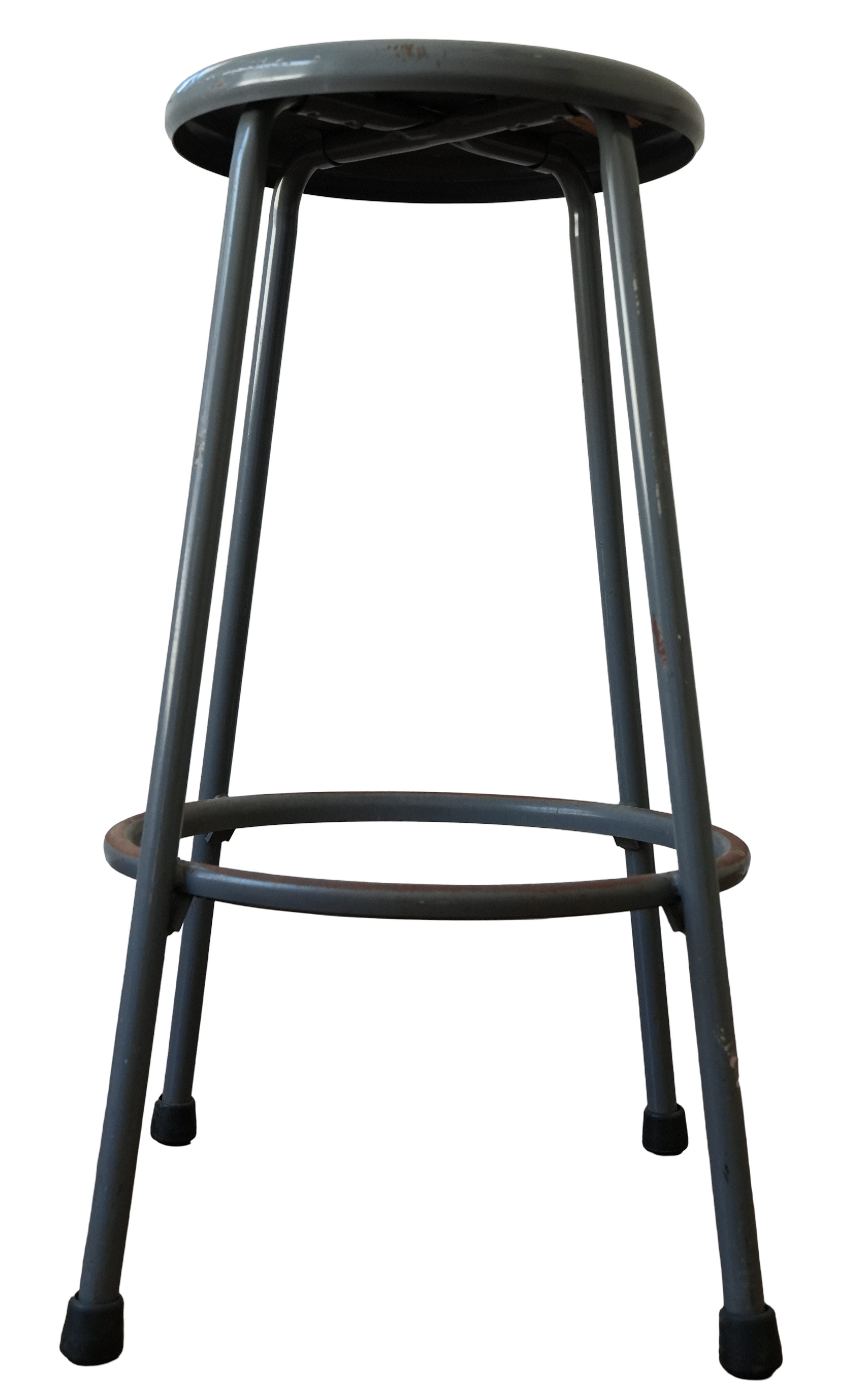
I type my morning freewrite on a typewriter at a standing desk. It’s more like a podium, really. It’s tall enough that I can stand at the machine and let the words come with body upright, slightly engaged.
The rest of the workday happens at a desk I built from iron pipe and a custom-cut sheet of glass. I love my desk. It fits me when I’m sitting. I sit in a Steelcase Leap 2 — a “nice chair,” the kind of chair people who research on Reddit end up buying. It does what a chair can do. People like it because it flexes when you move around. That’s actually what annoys me most about it. I got it because I end up sitting cross-legged in a chair about half the time, and it works.
It’s still a chair. The point being, even if the ergonomics are good, entropy will take over. When your body stays in any position for any length of time, bad things happen to your body.
The experiments
I’ve tried...maybe all of the alternatives. Squishy ball chair. Stool. Weird meditation platform chair. Floor desk. Couch. Sit/stand desk. I even built a laying-down desk — a wooden frame with a tablet and keyboard velcroed into place so I could work horizontal like some kind of recumbent astronaut.
It was hard to actually get any work done laying down. There’s something about the body’s relationship to the vertical axis that affects the quality of attention. If you’re too upright, things get a little too military-monkish. Too relaxed, you turn into a dreamy potato. The chair is a compromise.
Cue the sinister music, because there’s a dark secret lurking behind the effects of sitting too much.
What’s actually happening
Here’s what the chair is doing to you, slowly, whether you notice or not.
Thoracic kyphosis — the upper back rounds forward, the chest caves, the shoulders curl inward. That’s your thoracic spine taking the shape of the chair. Do it enough and the curve starts to set.
Anterior pelvic tilt — your hip flexors shorten from being bent all day, and they pull the front of your pelvis downward. The lower back overarches to compensate. It’s why your back aches even though you haven’t done anything. Sitting is doing something, it’s just doing it so slowly you don’t notice until it hurts.
Fascial adhesions — fascia is the connective tissue that wraps everything in your body, muscles, organs, all of it, in one continuous web. When you don’t move through your full range of motion, the fascia gets sticky. Layers that should glide past each other start to bind together. You lose mobility because the tissue around the muscle has basically glued itself in place.
What this does to your attention
The postural damage from sitting becomes more than just a body problem. A caved chest restricts your breathing in a subtle way. If the breath stays shallow, stays in the upper chest instead of dropping into the belly, the nervous system goes into a low-grade state of alert. A nervous system on alert is more reactive, so it keeps you on the surface of ideas.
Fascial adhesions rob the body of its ability to feel things flow. A body that’s glued together in places can’t quiet down.
People do all sorts of stuff to force themselves into states of consciousness. But if you can get the body to settle first, the mind can clarify in the wake of the body’s settling. When I stand at the typewriter and the rhythm of the keys starts to organize my breathing, my posture, the tempo of my thinking, that’s a bodily event. The mind follows the lead of the body.
But it can most easily follow a body that’s free enough to find the rhythm in the first place. If your chest is caved, your breath is shallow, your hips are locked, and your fascia is stuck, you’re trying to settle into creative attention inside a body that isn’t happy about itself. No amount of willpower or discipline fixes that.
That’s what these corrective postures are actually for. They help restore the conditions under which real attention becomes possible.
Here are some corrective postures to help undo them.
Good ol’ downward dog
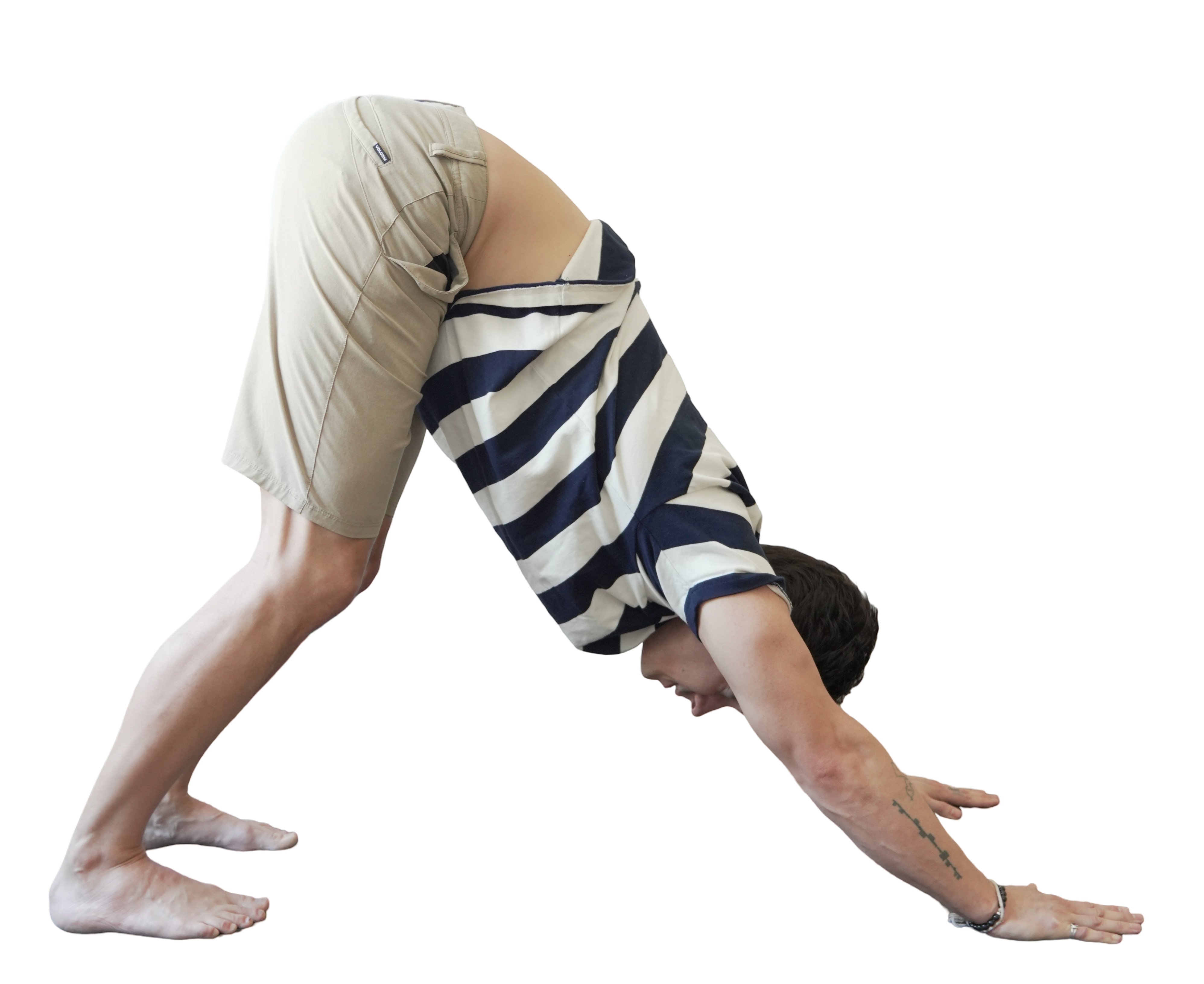
Nothing beats it. Hands and feet on the floor, hips high, spine long. It decompresses the entire back chain, from shoulders, spine, hamstrings, to calves, all at once. It’s the single best reset I know. Do it several times a day.
All hail downward dog pose. Start with knees bent and get the upper back feeling aligned, then go deeper if it works.
The dead hang
This is the big one.
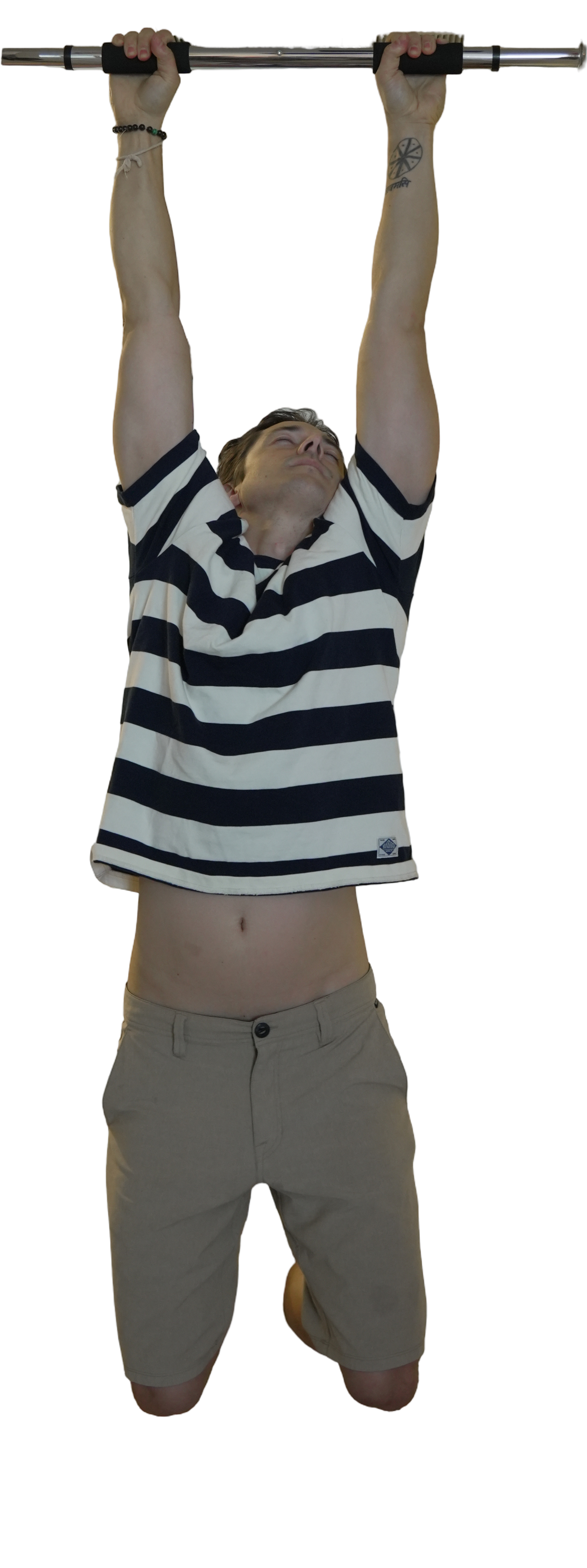
Hang from a pull-up bar like a monkey with nothing to live for. Just grip the bar and hang there. Let your spine decompress, let your shoulders open, and gravity will do the opposite of what it’s been doing to you all day. This is the most direct counter to thoracic kyphosis. The weight of your body pulls the whole spine long and lets the shoulders fall back to where they belong.
Most people can’t do this for more than a few seconds before their grip gives out. That’s fine. My bar is in a doorframe, low enough that my feet can touch the ground so I hang with knees bent. That allows me to ease into it, to gradually shift my bodyweight onto the bar, rock side to side, flex a little.
There’s research that says our shoulders were designed for this, that hanging is one of the most natural postures the human body can assume. It just doesn’t look like it because we’ve spent the last ten thousand years not doing it.
Fish pose
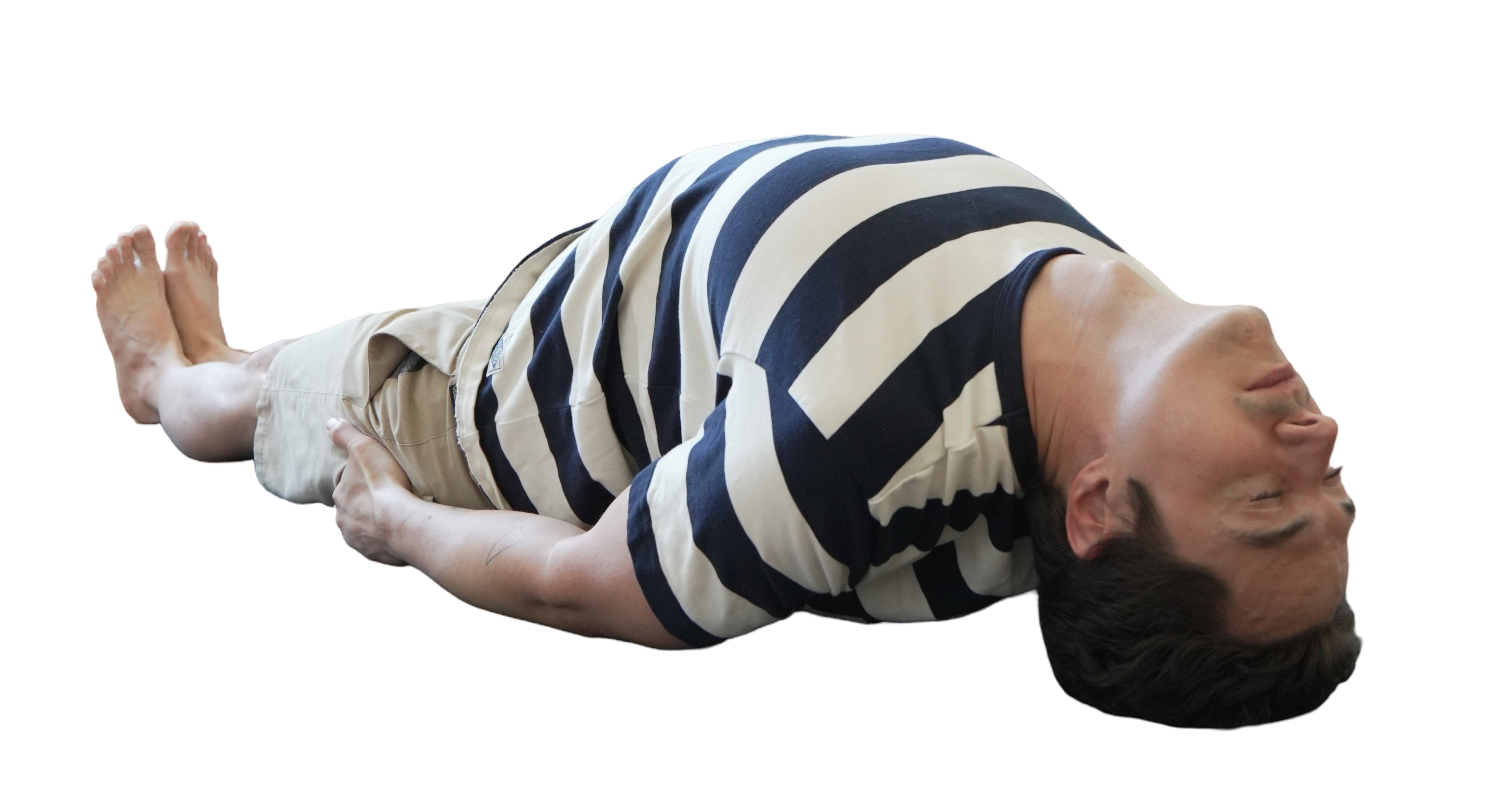
Lay on your back and arch your chest upward, crown of the head touching the floor. Grip the underside of your leg bone so you aren’t putting any body weight on your head or stressing the cervical spine.
This is the anti-desk pose. It opens the chest and throat, reverses the forward curl that sitting creates. A few minutes here and you can feel the front of your body expand.
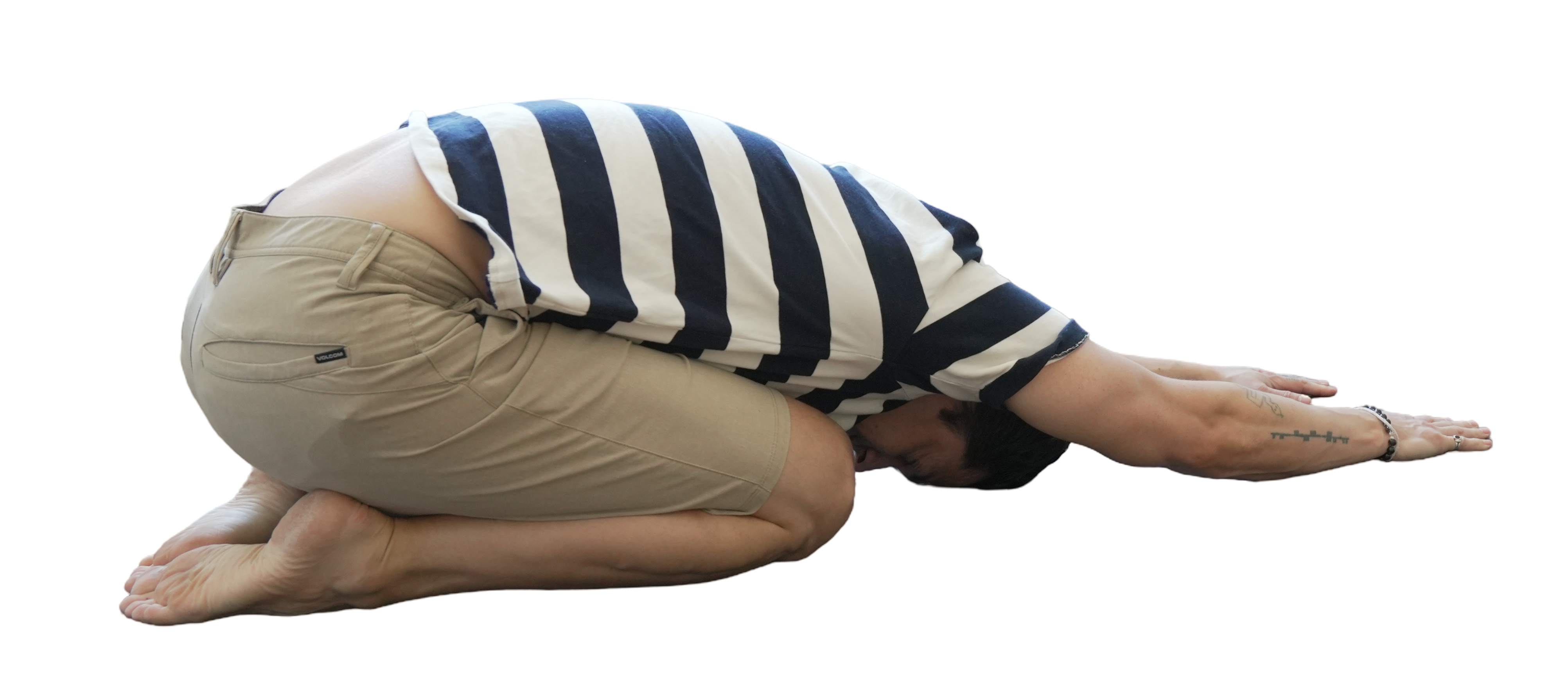
Child’s pose
Legs extended or wrapped around your side. I like doing arms extended. Knees on the floor, sit back on your heels, fold forward. This one is less about stretching and more about settling. The nervous system likes it. The lower back likes it. I feel it in my lats and upper back. Come here between the more active poses.
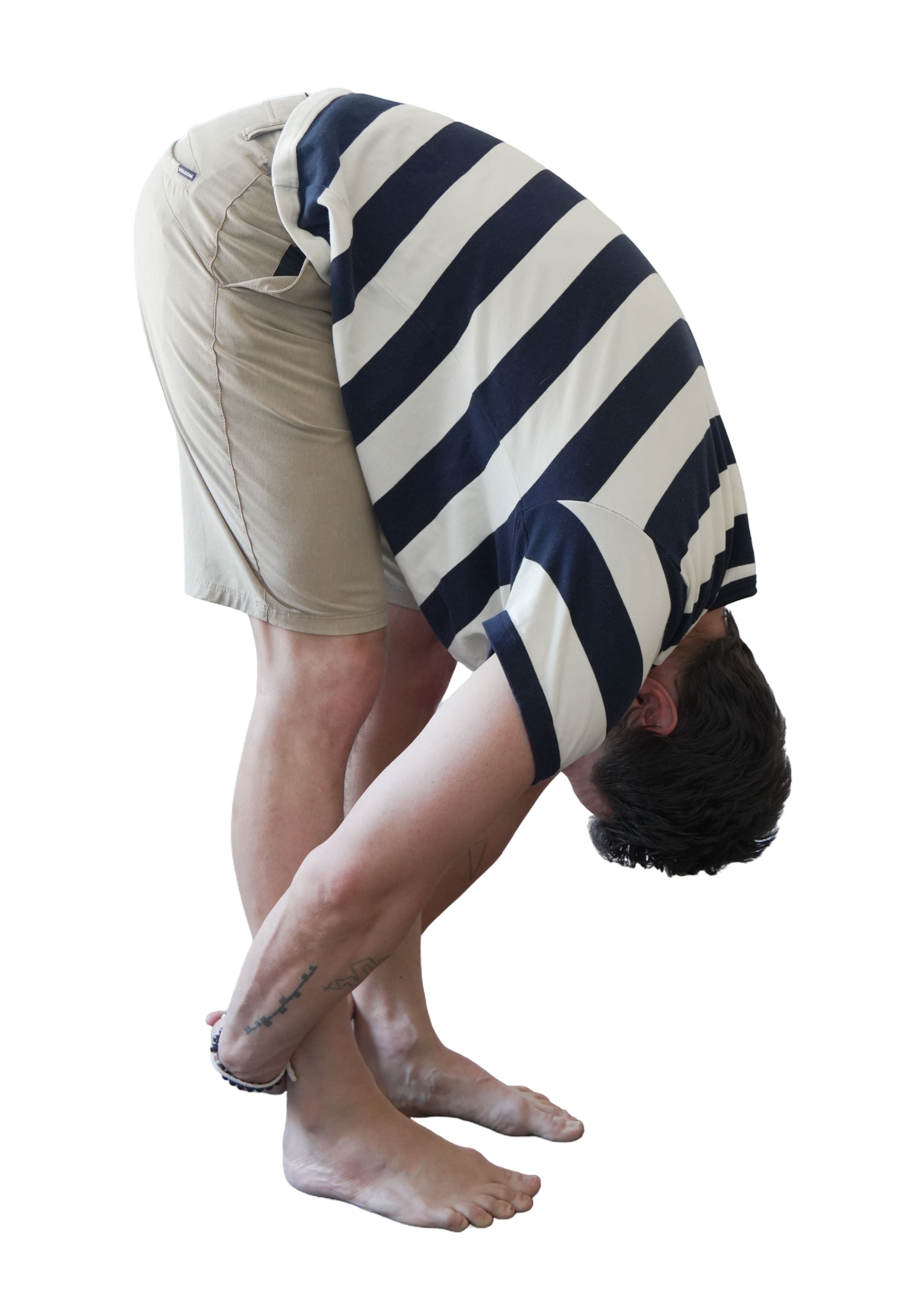
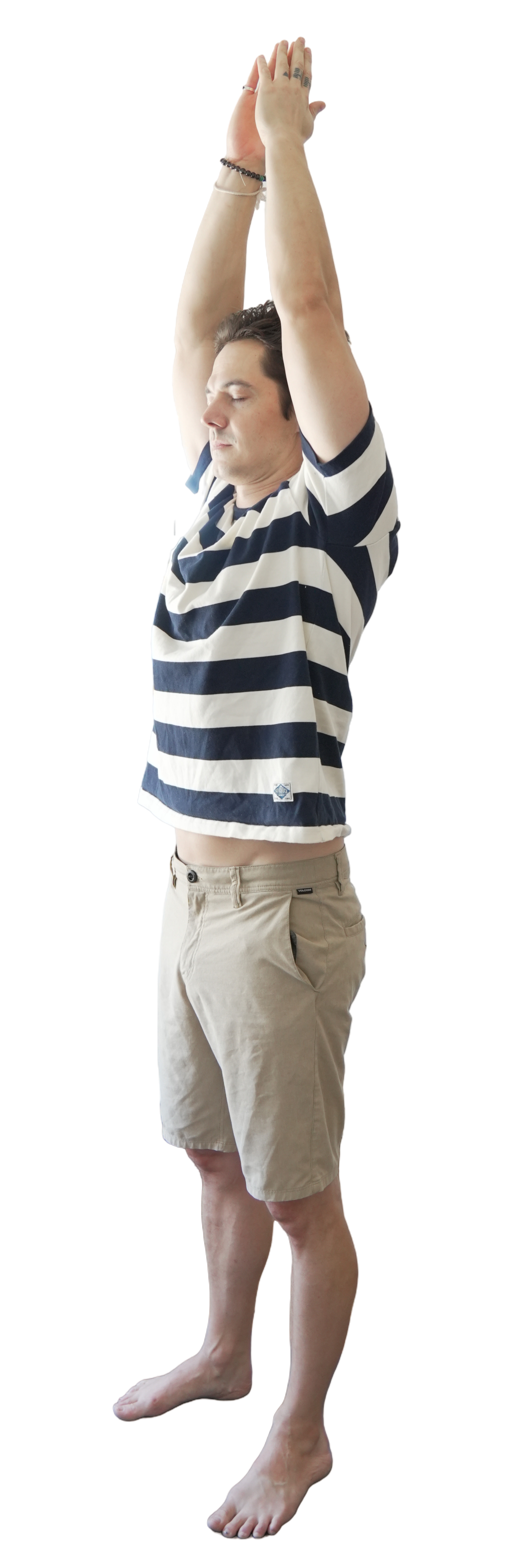
Forward fold and upward reach
Standing, fold at the hips and let your head hang. Then come all the way up, reach overhead, hands steepled or in prayer, and stretch side to side. Up, down, forward, side, side. The whole vertical axis of the spine needs to move through its range. Desk work keeps it locked in one narrow band.
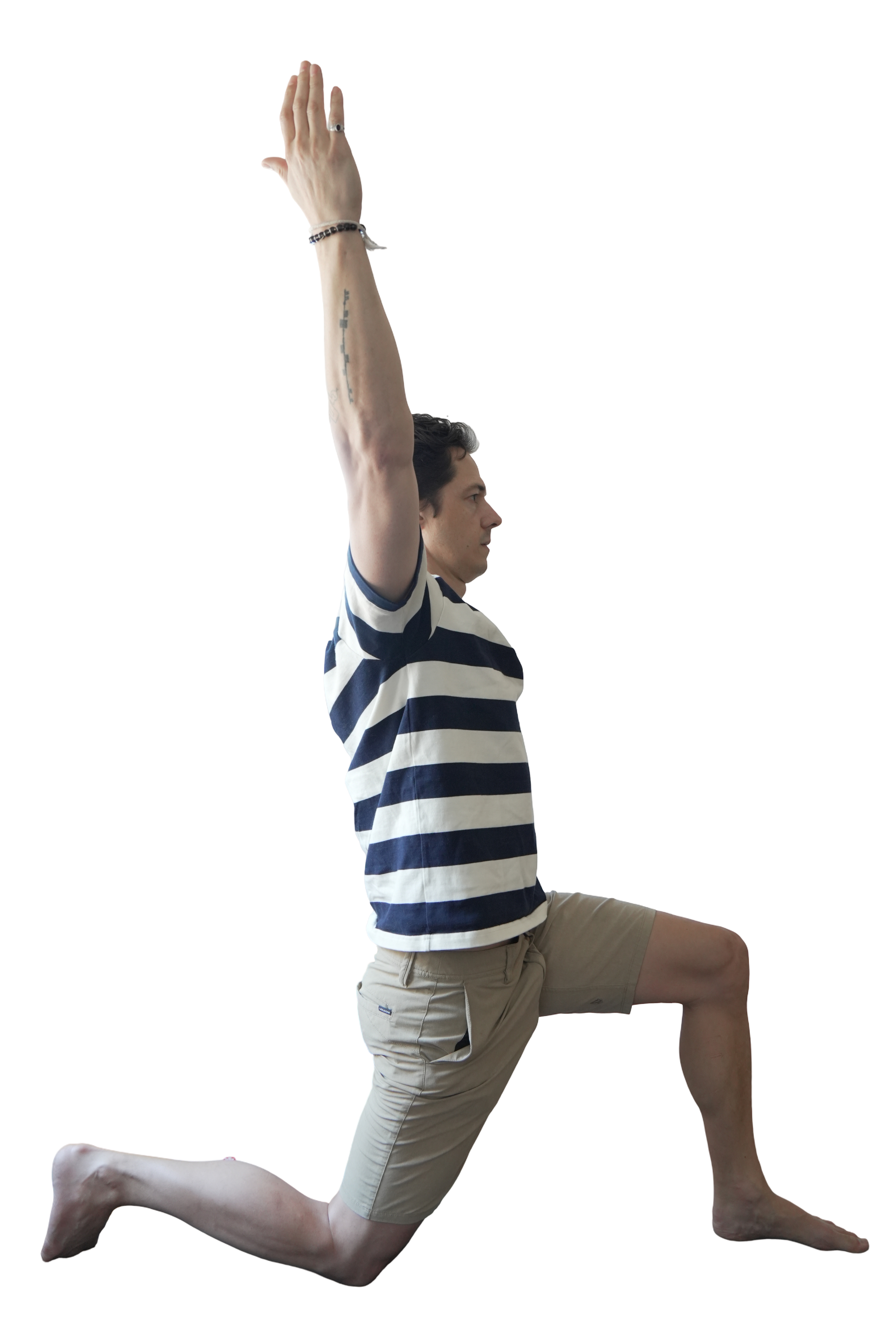
Low lunge
Step one foot forward, lower the back knee to the ground, and sink into the front hip. For some people, the real damage from sitting hides in the hip flexors. They shorten and pull the pelvis forward into that anterior tilt. The low lunge helps. Ease into it, hold it long enough and you can feel the front of the hip releasing its grip on your whole lower back.
Knee down gate pose
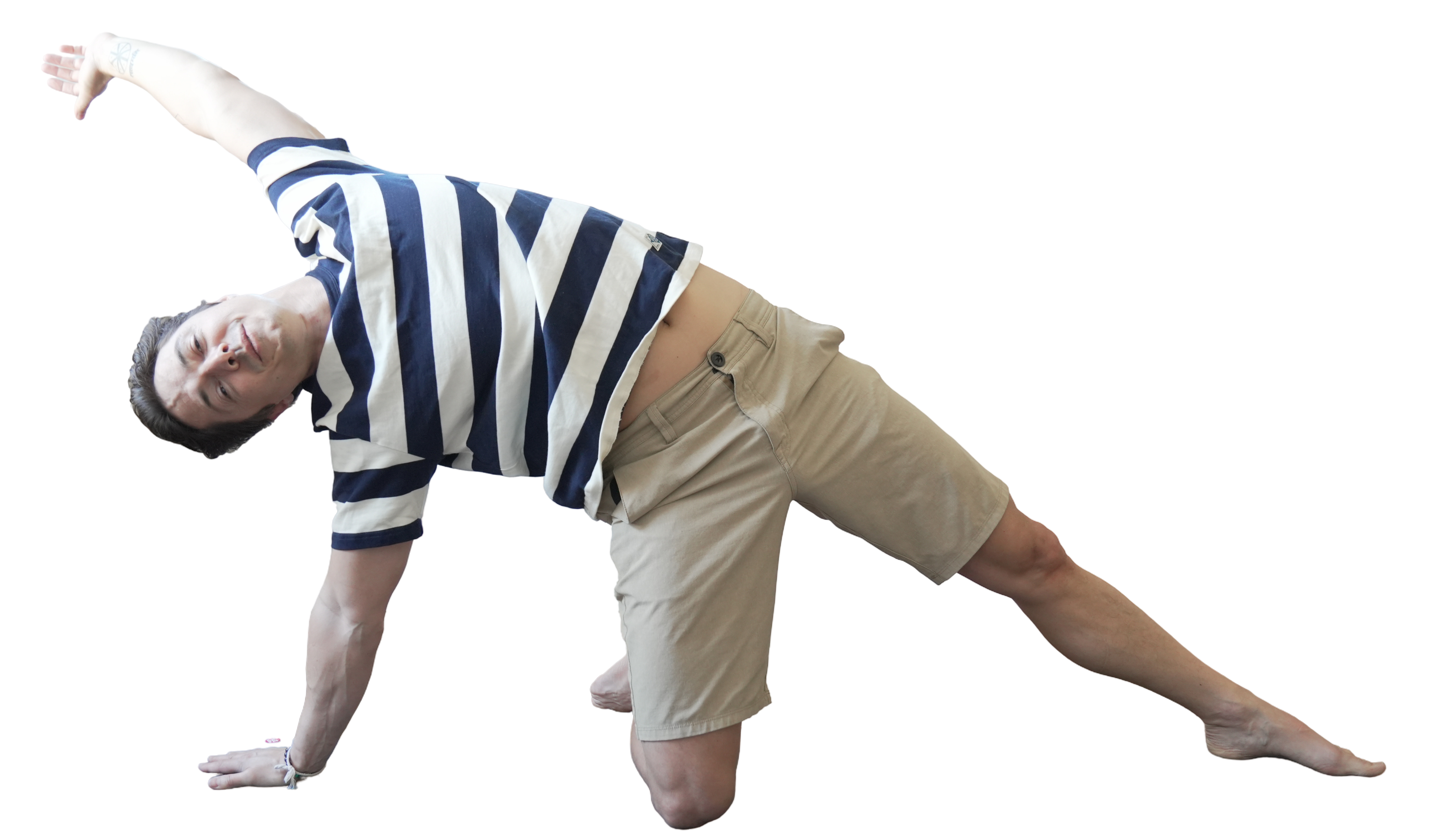
Right knee down, left leg extended straight out to the side. Lean to the right and plant your right hand on the mat beside your knee. Extend your left arm up and over — reaching long, following the line of the extended leg. You should feel it open the entire left side of the body in one continuous stretch: outer hip, obliques, side ribs, all the way through the lat and into the fingertips. Hold, breathe into the long side, then switch.
Beyond stretching
There are more poses, but you get the point. The point is to move the body all throughout the day in a lot of different ways. And one thing to emphasize is that fascial adhesions don’t release from stretching alone. The fascia is one continuous web. It needs varied movement and sustained gentle pressure.
Don’t stretch cold muscles. Ease into it. And there’s something to be said for just working your body in a variety of ways — swimming, biking, hiking, jogs. Climbing. Pickleball, if that’s your thing. All very different movements that ask the fascia to glide in different directions, break up different adhesions, encourage different ranges of motion.
If you only do one kind of movement, you develop one kind of body, and one kind of body creates limitations.
The mind follows the body down
So you've hung from the bar, opened the chest, moved in a few directions the chair doesn't allow. Now you sit down to write.
There’s a moment, maybe five or ten minutes into a writing session, when something shifts inside. The sentences get shorter, or longer, or stranger. An image appears that you didn’t plan.
You can feel that shift in your body. The nervous system settles because the forward momentum and subtle bodily engagement from writing or typing gives both mind and body something steady to organize around. And the mind, which had been chattering because it had nothing to anchor to, starts to quiet.
It’s harder to reliably get to that state in a body that’s been shaped by a chair into whatever the hell a chair wants a body to be. So, the corrective work isn’t separate from the creative work. Every time you open your chest and unstick a fascial layer, you’re restoring an instrument.
The chair will win eventually. Someday I won’t be in this body anymore. In the meantime, I’m going to hang from a doorframe like a primate and try not to think too hard about it.
I’ve finally started using my standing desk, especially useful when I’m in a zoom meeting. This is an excellent reminder of how important it is to not spend time sitting.
Ah yes the humble chair. As a furniture maker the first thing that strikes me when I look at the Steelcase chair is it looks infinitely adjustable. Very wily Steelcase. They've fooled you into thinking that making their chair comfortable is your responsibility. You just tighten the knobs, pull the levers and adjust the bubber. Making a chair is a bit of the ultimate challenge as a furniture maker. The subtle and seductive art of cradling of the body. An attractive design and comfort in one package. Something a table doesn't need aspire to. Years ago I discovered the simple perch stool. Not quite sitting, not standing. It's not intuitive that it would be comfortable for hours and hours. https://www.geoffmckonlyfurniture.com/portfolio#/walnut-perch-stool/