

I had the good fortune of counting among my acquaintances a wonderful man who for a time was the owner of a landed estate in Tuscany and who acted as general manager of the farm operations. As you might expect about a landed estate in Tuscany, an abandoned castle dating back to the 11th century was on the perimeter of their holdings. Being a kid who grew up playing Dungeons and Dragons and reading everything by Tolkien, I had in my mind that because the castle was unused perhaps somehow someday it could become my castle.
I asked him about it once — why it was in good repair but not a tourist attraction, not being "used" for anything. You could take a trail to get there, part of which showed the signs of being an ancient Roman road, cobblestones still visible, but aside from that there was no real infrastructure. The story I remember was that they'd donated the castle to the province or paid to have a roof put on and in return gained some tax advantage, something of that sort.
And then he smiled and said something like, “You have to understand — according to the province, we are mountainously disadvantaged.”
He said it with some relish.
He’d put so much work into getting it to be a running farm, and a strongly principled one at that. They’d faced no end of challenges and setbacks, many of them financial. My own small experience building an off-grid home starting from scratch taught me as much. However much you think it will cost, and however long it will take, multiply it by four.
He meant that the province classified agricultural land according to how well it could grow things, and when especially hilly, for example off in the mountains, it was at a steep disadvantage. A mountainous one.
But you know what?
Look at that view.
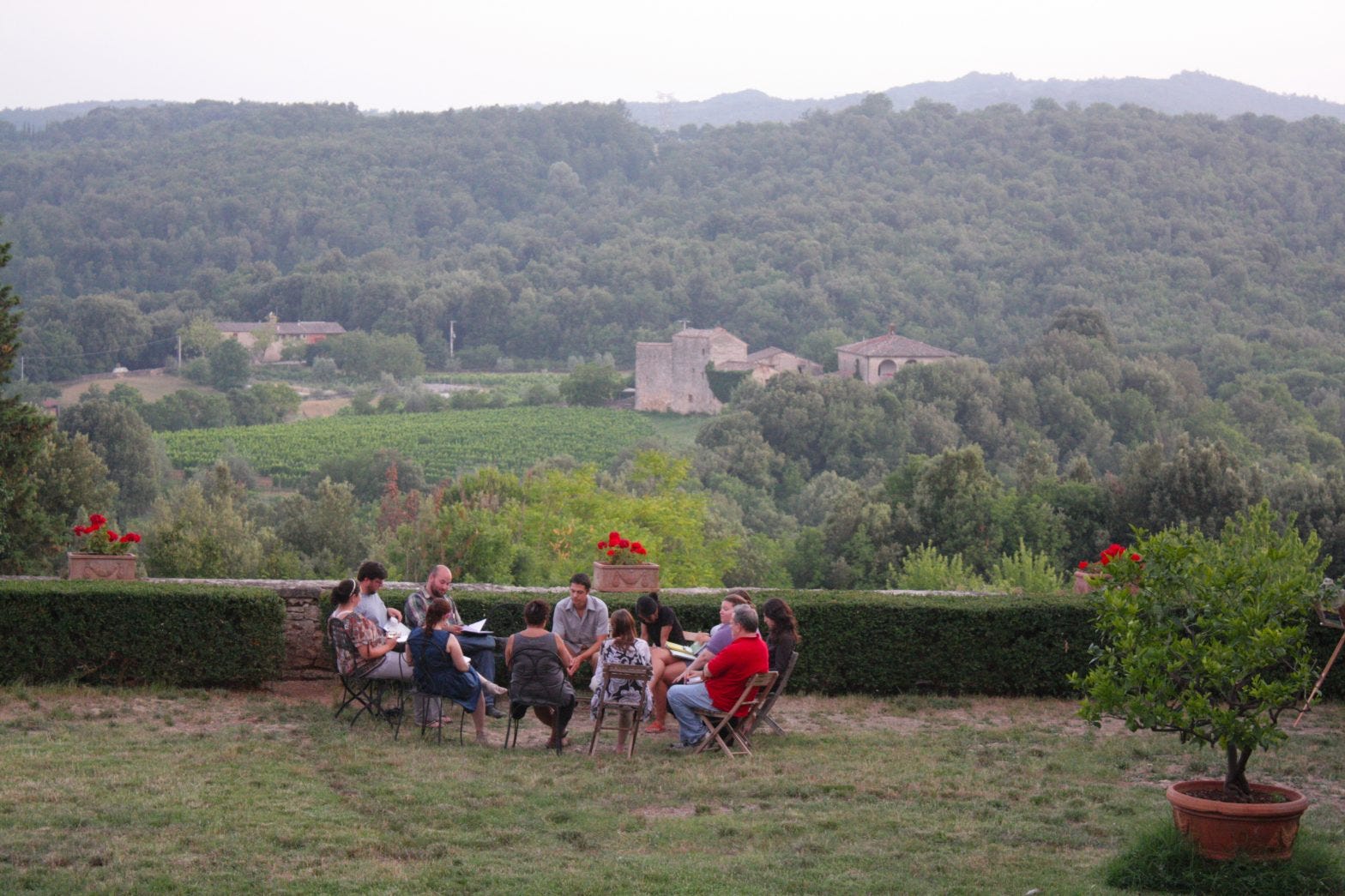
The province had a word for it
There’s a moral here I’m ham-handedly making about what’s mountainously disadvantaged actually being a massive blessing.
In my life I’ve variously wanted to be many things. I love growth but I also love change. I stuck with writing not because when I was a kid someone said, “You really blow me away with your linguistic eloquence.” I had some good teachers and a few experiences sharing stories and pieces as a kid that felt very positive and encouraging. But mostly I stuck with it because writing can provide both growth and change — you can do all sorts of different stuff with the same fundamental medium.
I’m not by disposition a natural writer. Stories and even phrases don’t readily occur to me. I’m not naturally talkative. I’m a feel-first person. I make sense of the world first through a visual and a tactile sense.
For me, writing is a very fast ongoing decision making process, like hunting thoughtforms playing Duck Hunt. When you bring your attention right there into the singular moment, any number of things could get said, and in any order. It’s simple, but the process always fascinates me. I have followed that fascination.
So yes, writing was not natural for me, but it has become so through tons of rote experience.
That's the thing about mountainous disadvantage. The mountainousness was what make the Tuscan estate so beautiful. It’s wooded, wild, with the kind of view you don't get from flat productive land. The difficulty and the beauty were the same feature.
But it also means there are two sides to it, and they need each other. One side is always going to look more practical. The other is always going to carry more of the view.
The other side of the range
Which is maybe why this story caught my attention more than most of the AI headlines that come and go.
Maybe you’ve read the headlines about the guy, Mrinank Sharma, who quit his job as the head of AI safety research at Anthropic, one of the companies building the most powerful AI systems on the planet — to go study poetry. He’d led the team responsible for figuring out how to prevent AI from going sideways. His last project there studied how AI assistants can distort our humanity. He has an Oxford PhD in machine learning and is a Cambridge grad. He’s also, it turns out, a poet.
The big AI conversations tend to be about which industries get disrupted. Sometimes it’s a game of “spot the hallucination.” This one is about poetry being the counterweight.
In his resignation letter, he wrote that wisdom must grow in equal measure to our capacity to affect the world.
Then he left to go study poetry.
I’ve been thinking about this for a while now. That statement reads like the kind of thing most people would nod at and scroll past. But I think we should take it seriously as a design principle. As the tools get more powerful, the inner work has to get more deliberate.
Feeding the poetic
When one side picks up momentum — and it is, fast, that much is obvious to anyone watching — the other side has to be getting more investment. The corporate and technical world is getting plenty of praise, so let’s feed the poetic. Everybody’s questing for the optimized life, so let’s dive the fuck into rote learning and embodied experience. Not because slow things are always more virtuous, but because they carry more warmth and presence, and also because they’re the counterweight, and without counterweight the whole thing gets gnarly.
That investment probably won’t be incentivized by the market, because the market has no reason to reward you for maintaining capacities that the tools have (arguably) made unnecessary… unless what you do with them upends that model and tilts the scales in your favor.
And that’s the weird thing about this moment. The new economy is mostly horrible, because white-collar jobs are vaporizing, inflation is eating everything, the gig economy is grinding people into interchangeable units. But alongside all that, there are people going deeper than the gig economy into something genuinely new.
A guy hand-forging knives in his garage builds a YouTube following that outearns his old engineering salary. A woman leaves consulting to make ceramics and sells out every batch before it’s glazed. Plenty of weirder examples abound of people pursuing something that matters to them, getting good at it through rote experience, and discovering there was an audience starving for exactly that kind of presence.
It happens all the time with random creators and influencers. Isn’t Mr. Beast a bazillionaire now? Of course he is. But even more important than the fact that many people are finding success is that they’re doing it because they get joy from it.
If it gives me joy, there’s some chance it can do the same for others. If it doesn’t, there’s zero chance.
I’ve never loved anything I’ve read where the author didn’t get at least as much joy out of it as me.
The average person suffers from so much harsh inner criticism about being imaginative and experimenting with art. Stop. It sucks. No. Who are you to do this. Be practical. More than anything, these short evil phrases stand in the way of someone doing something amazing. They're the voice that says the flat, productive land is the only land worth farming.
But the view is up on the mountain. Sharma knew that. He was standing in the heart of the valley — maybe the most “practical” job on the planet right now, keeping the most powerful AI systems from going sideways — and he walked toward the mountain. He’s right that wisdom has to grow in equal measure to our capacity to affect the world, and poetry is how to grow it.
The things that look obsolete and mountainously disadvantaged, if they feed your wonder and fascination, are the things keeping you fulfilled. Start there. Nothing changes the world for the better that didn't first change the person who made it.