

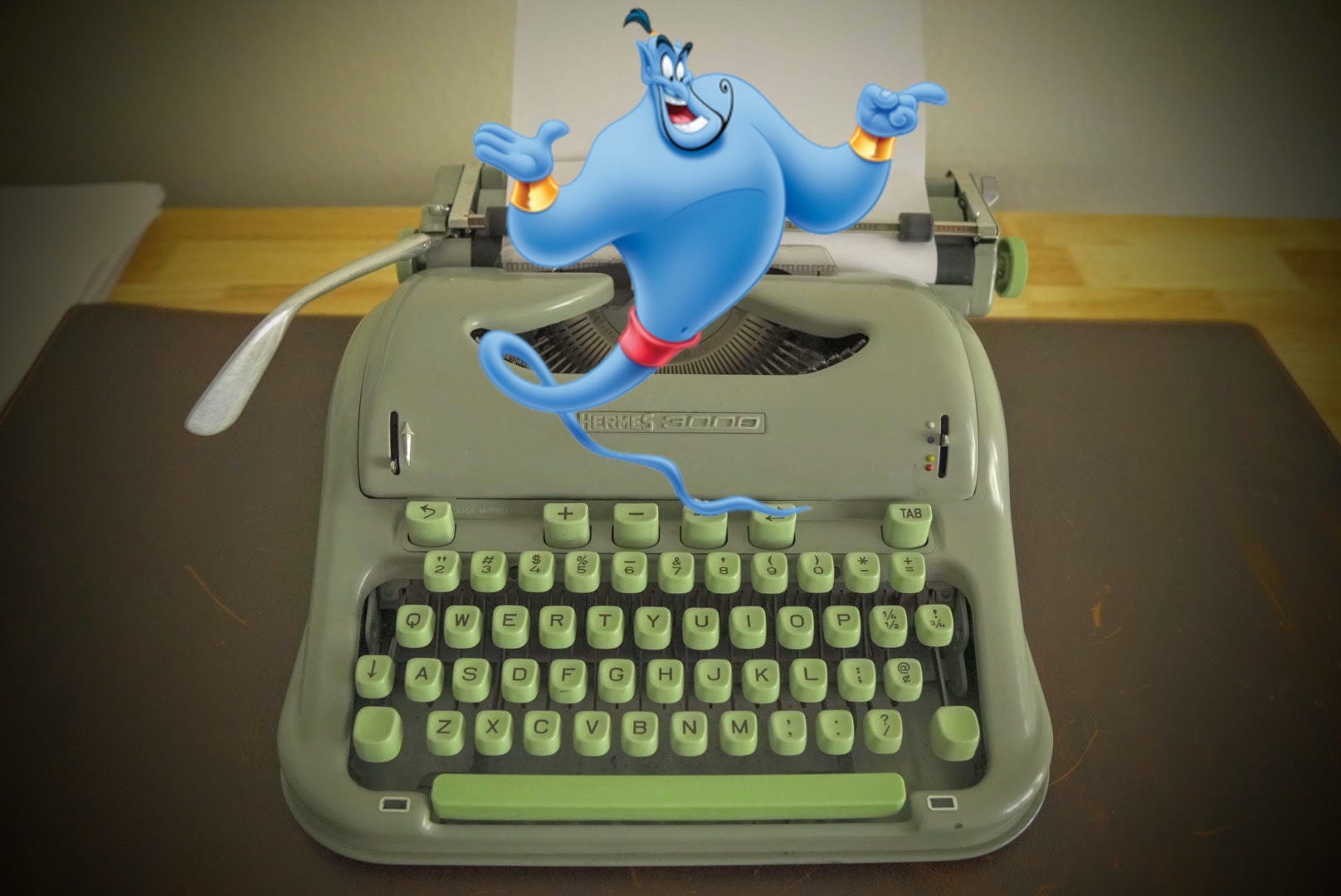
I’m hitting the keys of my typewriter and the action is balanced so that the lever explodes the ink onto the page—wham wham wham wham wham—and yet my fingers keep this circular momentum going, like feet on a bicycle, feeding one stroke into the next. The carriage chunks forward with each keypress and there’s a faint smell of ink from the ribbon. The words pop like fireworks crisp onto the grain of the physical page.
An hour later I’m at my desk, different project. Two wide screens fill my field of vision, bright and flat. My fingers tap plastic keys that barely move. I’m drafting a chapter outline, I’m able to cut and paste and reorder chunks of text. It’s damn convenient. It’s sleek, but there’s not that feel. The words are forever behind glass, pristine and yet unsensual, like watching something beautiful that’s locked behind a display case.
Sometimes I wake in the middle of the night and impressions come to me. Reflections about my life, about the state of things. What came this time was about AI, about this sense most of us carry that things will get “back to normal” someday. Unfortunately, I don’t think there’s truth in that hope, so I’d rather receive the dread for whatever wisdom it has to offer. AI is here to stay. You can’t put a genie back in the bottle.
Let’s suppose the genie is good
Let’s suppose AI gets to the point where it becomes an amplifier rather than simply a good shortcut machine. Let’s say that in the hands of the right person, it magnifies the quality of output. Let’s imagine only a positive possibility of a world with AI. I can collaborate with my AI companion. I can burp and belch and bleat out inarticulate requests and half-thoughts and it helps me build a detailed outline, a world-built backdrop for a science fiction thriller, a cast of characters, a chapter-by-chapter flow that at a glance looks like a durable foundation. I can do this in an afternoon. Let’s suppose that what it produces is good.
Right now, AI is mostly something that gets sold by a few large companies and its most exciting consumers are governments and large corporations, entities that tend to be more about quantity than quality.
To the extent that AI could become a true creative tool, I like the idea of it being available to the average person for free, as something they can actually own, customize, and make their own. Let Average Joe decide what it can do for him and what it can’t. At least in this scenario, AI can be an equalizer. Or can it?
I’ve asked that we entertain the belief that AI actually is a creative tool. So where does that leave us? Does life get easier?
Two things happen, and neither of them is life getting easier.
We simply come to expect more from each other. We already see this. Corporations are AI-washing—laying people off, and it may or may not be because of AI, but let’s say it is. This will continue. Let’s not presume things will ever go back to the way they were. If output is cheap, we’ll simply expect more output.
It used to take two weeks to get something in the mail. Now unless shipping is free, we’ll go to a different merchant unless the friction of creating a login at that new merchant is too high. I caught myself the other day abandoning a purchase because a site wanted me to create an account. In the past I would have just done it. Now that tiny friction was enough to send me back to Amazon. Progress orients us toward the mirage of frictionlessness but what it guides us to create are new sources of fragmented attention. In this landscape, monopolies form and grow their moats.
It’s easy to disparage techbros and large corporations. But what’s a mom-and-pop shop likely to do? The same thing. Because cheap output is cheap for everyone.
And we value everything less. There used to be just radio. Then a few stations in black and white on television broadcast over the air for free with ads. Now you can get nearly anything, anytime.
I see people on LinkedIn making claims that we’ll come to value the “human touch” more. I don’t think that’s automatic. It will become rarer, yes. But people say things in defense of their positions. They’re worried no one will care or appreciate what they do, that a machine will replace them.
This isn’t about nostalgia
So what do you do when the thing that might replace you is also genuinely useful? You stop defending your position and you go deeper into it.
Here’s what I think actually survives: not the human touch as some sort of a value-add, but the act itself. Hands on keys. Ink on a page. The physical reality of making something and being changed by the making of it.
We’re not output; we’re not material objects. We’re here in this life for a short while. Maybe some people want to make a big splash with their art. Most people don’t genuinely want that. But that doesn’t mean art has less to offer them. It may in fact have more, precisely because they’re not wrestling with the artist persona, the legacy, what the fans will think. Without that pressure, plenty of things can be transformative.
You can take a trip to a different hemisphere. You can do a vision quest in the desert for a week. Those things work. But art is something you can show up to day after day, apply some effort, and get yourself reflected back to you as you apply your will to something.
You can’t do that with a trip, because a trip is mostly passive. A creative practice requires you to open yourself and apply yourself and put yourself out there. You bring something of how you see the world and you alchemize a bit of yourself in the process.
What does that look like? It can be journaling, freewriting, morning pages. It can be learning pottery or picking up a pencil and drawing what’s in front of you. It can be learning an instrument, badly. Posting about your process. Sharing what you’re up to. All the adjacent things that have nothing to do with the finished product.
And it’s something you can do without pressure or strain. It’s energetically supportive. People turn to art because it’s soothing or restorative.
The output goes out into the world and does its thing. But the process is where you feel yourself thinking and making and choosing. If you let that get swallowed by expectations ratcheting upward, by the sheer insistence of it all, you lose the only part that was ever yours.
A typewriter is a great example because despite being mechanical, somehow working on it brings a soft space. It makes a noisy cocoon of sorts that dispels any doubt to an observer as to whether words are being given form. Typing has a clearing-out quality to it—bam bam bam—like shaking dust out of a rug in the sun.
I’ve had sessions where nothing good comes. Thirty minutes of toilety swill. A friend of mine, a writer on retreat, described it that you write through the garbage to get to the other stuff. And sometimes that’s true, but sometimes you just write garbage the whole session.
But so what? It’s like having a lousy meditation. What matters is that you honored the appointment and tuned in. The effects compound whether or not you notice them. You do it again the next day, and the next, and a year later you’re a different person because you were the one sitting there.
If we’re not affected by what we do, then we’re not really here.
AI is a threat based on how it gets used but it’s neither here nor there with respect to inner life. It plagiarized your book and it really might take your job. It can also be really useful. Output will keep getting cheaper, but the process never was. The typewriter doesn’t know about any of these things. It’s an irreplaceable creative tool because all it does is respond to the movements of my hands, and so I thwack-thwack-thwack away and smell the ink as it gets hammered onto the page.
What’s your version of the typewriter? The thing you show up to that has nothing to do with the output? I’d like to hear about it.
I have a spot opening this spring for a ghostwriting collaboration—a book, thought leadership, a company blog, or a personal project. If that’s you, reach out.