

I’m groaning as I write this, because so much has already been written about AI, and for so long. The tools have been used to plagiarize, to flood the market with slop, to replace workers, and maybe to drive the economy into oblivion as new datacenters get built with high-pollutin’ power plants.
More and more publishing news is about book deals getting canceled because they were written by AI or even suspected of being AI-assisted.
So authors are being given good advice about what the hell to do. Carly Watters, a literary agent whose newsletter I enjoy, published a piece this month on how writers can protect themselves. You protect yourself by not writing with AI and documenting your whole drafting process so you can prove how your book got made. And so on.
Makes sense given the current climate. Bear in mind this mostly matters if you’re seeking traditional publishing. If someone asks how you wrote your book, you should have an answer, and it should be true. But the safeguards, as framed, point outward toward an imagined accuser. The idea is to be able to prove your authorship of the manuscript. But what a dent it makes in the creative process to have to hold that stuff in mind the whole time you work. That’s winning the battle and losing the war.
The gnarled present
The present moment happens to be an unusually gnarled one. People are avoiding em dashes and running writing samples through AI detection software. It’s painfully ironic that AI gets trusted to detect AI. There are no real industry standards, so publishers lean on third-party AI detectors because nobody wants to trust their own discernment. And the technology changes radically every few months, which means a defense designed to satisfy the fear has to be reassessed when the tide turns.
The same practices, pointed inward, don’t expire.
If your word processor wants to finish your sentences, you can turn that on or off. But turn it off because you want full control, and for no other reason.
You should document your process insofar as doing that means you’re advancing through the stages of a finished draft. Hang onto the legal pad where the middle of your novel got worked out, coffee ring and all, because it’s beautiful to see how things looked at that point in the work. But nobody should have to withstand an audit of the supply chain of their romance novel.
Unattributed hands
About that supply chain. Publishing has always had one, and it included ghostwriters, developmental editors, book doctors, agents, and copyeditors. The sole-author manuscript was never the norm at the commercial level, despite what the industry prints on the cover. I know because I work as a ghostwriter and editor. Why cancel one writer for using AI when the next hired a ghostwriter?
Probably because we have decided that a ghostwriter’s words can be owned, and a ghostwriter can be held to account. Also, a ghostwriter takes longer, which keeps the practice from flooding the market with low-effort slop. And a ghostwriter gets paid for the work, whereas the models were trained on work nobody paid for.
Those reasons make sense, except the cancellations seem to believe that a manuscript is poisoned because it passed through AI somewhere along the way. That’s bananas. A manuscript is not a urine sample.

Putting on my ghostwriter hat, am I angry that people are using AI to help them finish the draft of their book rather than paying me to write it? Some days yes. Most days no. For one thing, it means more editing clients. Finishing a draft doesn’t mean the work is done, and I love working with authors as a developmental editor. An AI-assisted draft has its own challenges, but messy human drafts are no cakewalk.
And anyway, my reference shelf has been migrating my whole working life. Where I once would have called a friend or driven to a library, that changed with Google, and it’s changing again with Claude. But AI isn’t going to pollute my drive to write, make pottery, or sit and meditate. It’s helping many people plan, structure, and finish projects that mean a lot to them. That’s a huge positive.
The legal asterisk
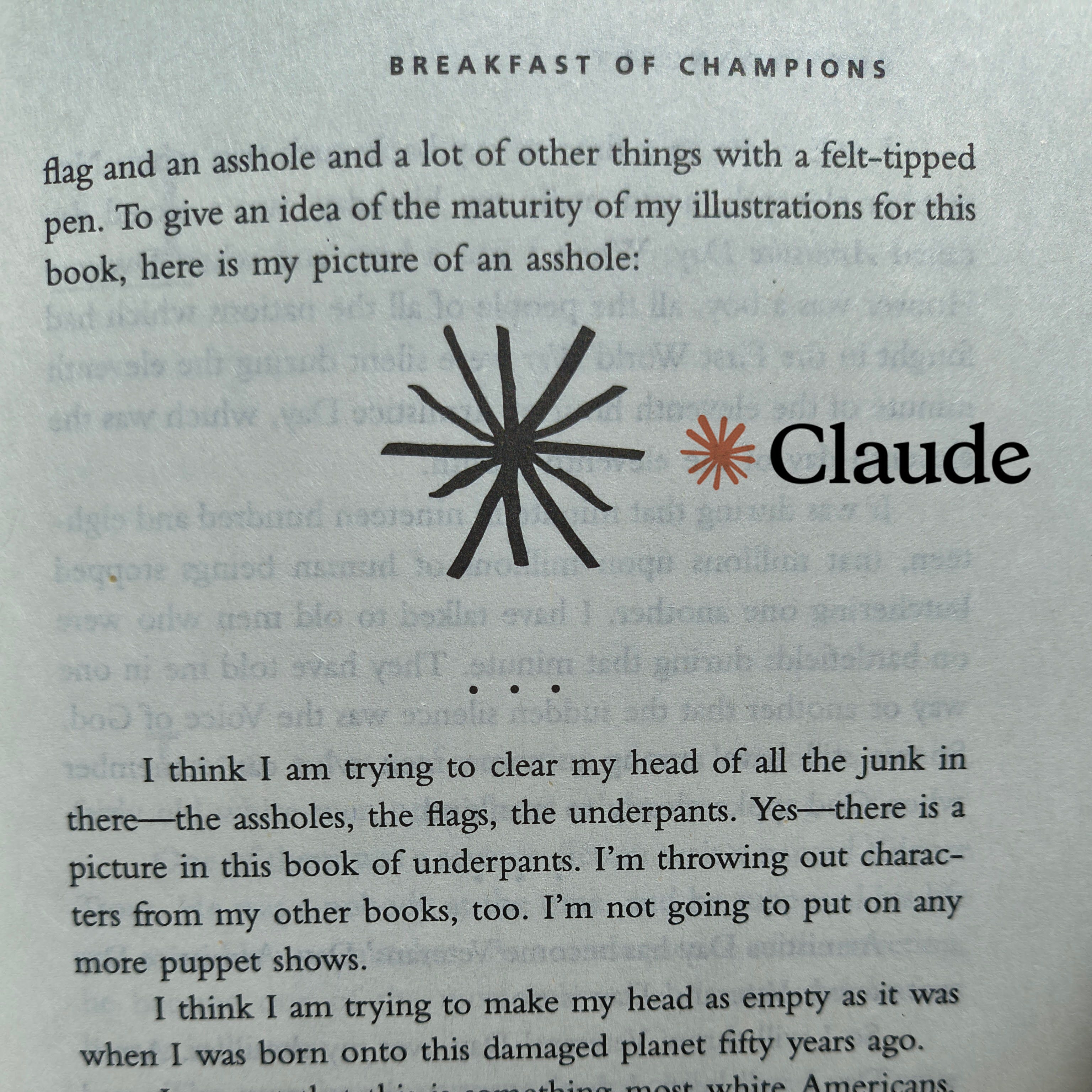
Last summer a federal judge ruled that AI training on lawfully acquired books is fair use, and that downloading millions of pirated ones is not. Anthropic settled with authors for roughly $3k per book. Checks are slated to start going out soon, although an appeal was filed in August, so “soon” carries an asterisk. Fitting. Of course I filed a claim. Who wouldn’t want to get a check from the company whose logo is Vonnegut’s asshole?
But all that stuff has to do with the marketplace and the legal system, and the whole point is to keep corporate platforms and the courts out of your creative process. That’s the one place you’re supposed to be truly free.
The long view
What will the future hold? Whatever gets sorted out in the courts, you can learn most of what you need from independent publishing. Indies have real agency, so they set the tone. But if you look at the flood of what Richard Polt calls slopbait, it isn’t consoling. Low-effort content is polluting traditional channels and making it even harder for real creative work to be discovered.
I would like to make the claim that garbage content won’t stand a chance because people care and are discerning. But many readers will not care how the thing got made. They’re looking for something cheap and that’s what they’ll pay for. This will result in actual working writers in a commodity market having the hardest time.
That’s the part that leaves me gloomy. What happened to workers in other trades will leave its mark on commodity creativity, and you can’t stop it.
I guess this has happened before, in its way. Plato worried that writing would rot memory. Editors once found typewritten manuscripts cold and impersonal. Photography was supposed to kill painting. In the ‘80s, people fretted about word processors.
All sorts of things are technologies, not just the new ones, and some are their own pinnacles. For me, count among them printed books, movie theaters, in-person events, typewriters, and good old-fashioned seated meditation.
Yes, there will be more junk food, both edible and creative. And no — the conclusion is not that things will be as they always have been, that people always find a way. I choose to believe that human creativity and warmth will prosper, but it’s by no means guaranteed.
How do I feel about AI? Put me in the “it matters how you use it” camp. Anything can be part of your creative process. Bring your whole self into the process by loving the work you do, and don’t be a puritan about what other people do.
I draft on typewriters, and not because I’m feverish about creating a paper trail. If I have one, it’s a side effect of the work, the way a kitchen smells like dinner.
If you have a finished draft that needs an editor’s help to cross the finish line, reach out. However you got there, I care about where it goes.
Absolutely my thoughts. The only way l see it.